

It was only when she had a mini stroke that Jubeda Islam accepted she needed support.
The demands of looking after seven children – two of them with very complex needs – and her disabled father had left Jubeda exhausted.
Richard House Children’s Hospice in Newham gave her vital respite and became “our safe haven as a family”.
But Richard House wasn’t there for Jubeda when her dad died. Its sudden closure last month left her without the support she said she “desperately needed”.
Jubeda had booked her boys in for a stay at the hospice so she could be with her mum and dad as he reached the end of his life.
But the closure of the facility meant that wasn’t to be.
Jubeda had to nip home for just five minutes to look after her boys, and that’s when her father passed away.
“It was a really big issue for me,” she told councillors in Newham last week. “I felt like we didn’t get the care that we needed. It was very suddenly cancelled.”
Richard House’s closure last month threw into the spotlight a problem we all hope we will never have to deal with – and may never have been aware of.
Hospices like Richard House provide end-of-life care for terminally ill children, along with therapies for children with life-limiting illnesses and complex needs.
They also give much needed respite to the families who take care of them 24 hours a day, looking after children for a short while so parents can rest, recover and live something of a normal life.
Yet most children’s hospices are run by charities and depend on donations. They get little funding – or control – from the NHS and local authorities. There are also very few of them.
A study by led by professor of palliative care Lorna Fraser estimated that there could be 22,227 children with life-limiting conditions in London by 2030. Yet Richard House’s closure leaves just four children’s hospices in the capital.
It’s an increasingly fragile model – and when it collapses, it’s the children and their families who suffer.
Families who used Richard House have now been transferred to another hospice, Haven House, in Woodford Green.
But those who were outside Haven House’s catchment area won’t be able to get at-home visits for respite care until at least April. That leaves some parents facing long journeys.
Jubeda told the Local Democracy Reporting Service (LDRS) that she used to get “hospice at home” visits from Richard House.
But now she says she faces a long journey to Haven House and a £50 taxi fare each way as she can’t take her son on public transport because of his seizures.
She says the distance would leave her with too little time to travel home before she had to return to pick her son up again.
“I’d just have to wander about in the area and that would be my only bit of respite,” she said. “Then having to come back again in the taxi – that whole visit would cost me £100.”
Charlotte Pomery of NHS North East London told councillors in Newham that parents would get “additional hours of care” at Haven House “equivalent to the number of hours they would have got through a hospice at home service”.
She also said that a transport fund would be used to help “those families that need transport support”.
But she acknowledged that parents had also lost long-standing, trusted relationships with carers at Richard House that can’t easily be replaced.
Ben Moss, another parent from Richard House, said it had taken a long time for his son to become comfortable there.
He told the LDRS: “With my son, because of his condition it takes him quite a long time to get to know people so there’s a lot of anxiety with meeting new people.
“It took us about two years to really get to the point where we could start doing overnight stays. We don’t have a two-year transition here.”
Ben also said the closure had shown “an issue around the systems and how they fail to interact” – with the NHS and council care services scrambling to pick up the pieces after the closure.
Newham councillors discussed the closure at a health and adult social scrutiny commission meeting last Wednesday (14 January).
They heard that Richard House told NHS North East London ICB in September last year that it had a “significant” deficit and that it might have to close without “a merger or major financial intervention”.
However, Pomery said Richard House trustees only notified the ICB of its decision to close on Tuesday, 9th December – just over a week before its closure.
Pomery said the ICB had placed Richard House under “enhanced surveillance” because “we had concerns about the governance and quality of some of the care services being delivered”.
But she was keen councillors understood that while the ICB had “commissioned services from Richard House, it’s a charity and was governed by different regulations”.
Laura Eden, the council’s director of children’s services, also noted that, as Richard House was a charity, “the council do not have any responsibility or accountability” for its management.
But she said there were “lessons to be learned around collaboration” with services not provided by the council.
“In an ideal world we would have known well in advance that there were issues and concerns that could impact on children because we could have then worked together with parents and carers to ensure that impact was minimal rather than very rushed,” she said.
For some of the councillors on the committee, the closure raised questions about how healthcare service provided by the charity sector should be managed.
Labour councillor Ann Easter suggested that “perhaps at some point there will come a time when the hospice movement becomes part of the public realm rather than remaining in the voluntary”.
Some Richard House parents are also calling on the government to give more stability to hospice services with greater funding and legislation.
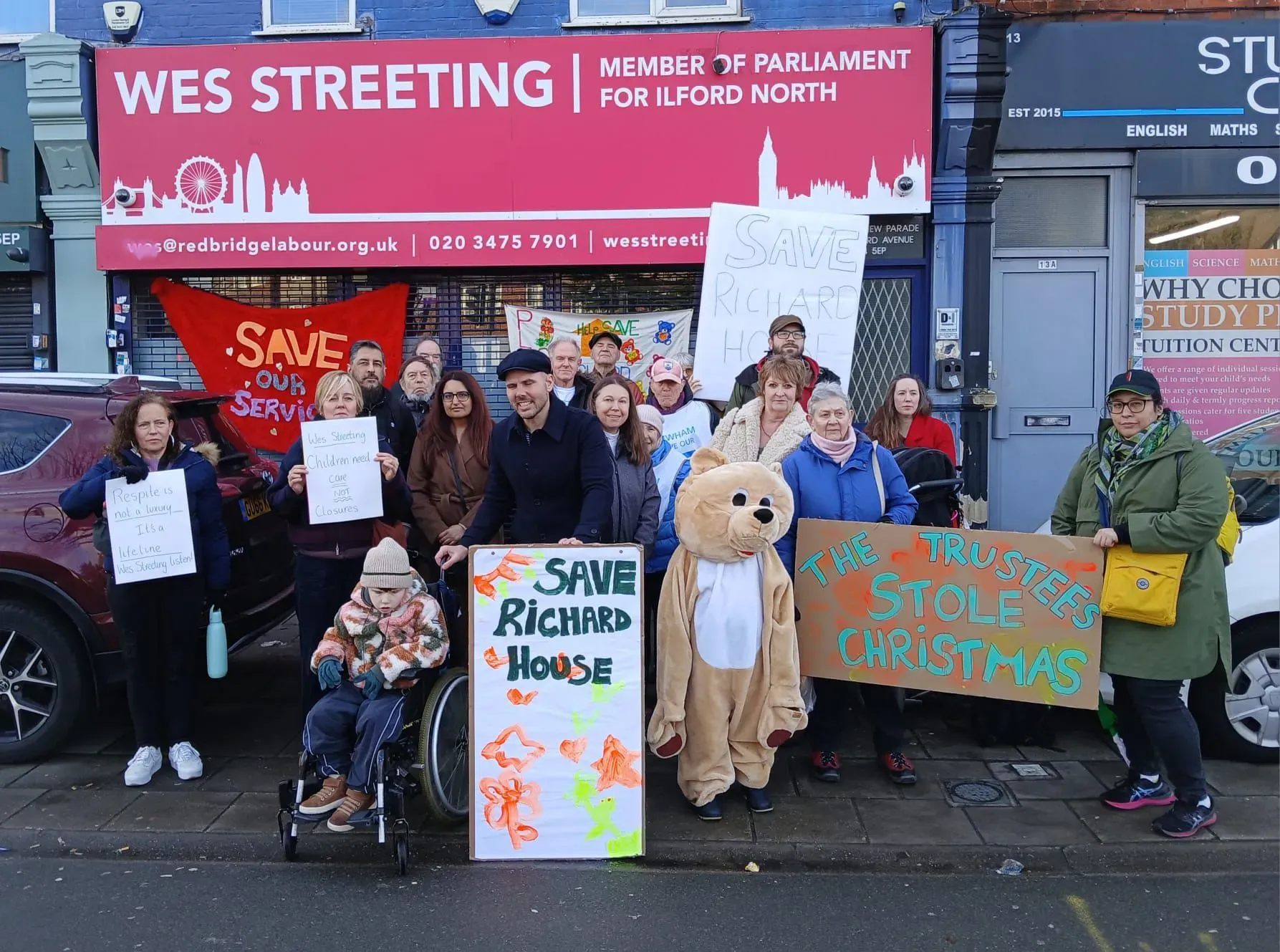
Campaigners protested outside Health Secretary Wes Streeting’s constituency office in Ilford last Saturday (17th). Their demands included “fair funding for hospices”.
Kareema Motala, one of the campaigners, told the LDRS hospice care should be made a “statutory provision”.
“There is a fraction of our children – and a growing number – that can only have their needs met at hospice provision. That should be in statute, it shouldn’t be outside of it.”


