

Newham Council has approved plans for five bright yellow wind turbines on the roof of a Royal Docks technical college — but only after London City Airport told the council the scheme had the potential to conflict with its aerodrome safeguarding criteria.
Permission was granted on Thursday (23 July) to London Design and Engineering UTC (LDE UTC) on University Way, for an array of enclosed, vertical-axis turbines made by Hover Energy, a Dallas-based firm. The application was decided by council officers under delegated powers rather than by councillors.
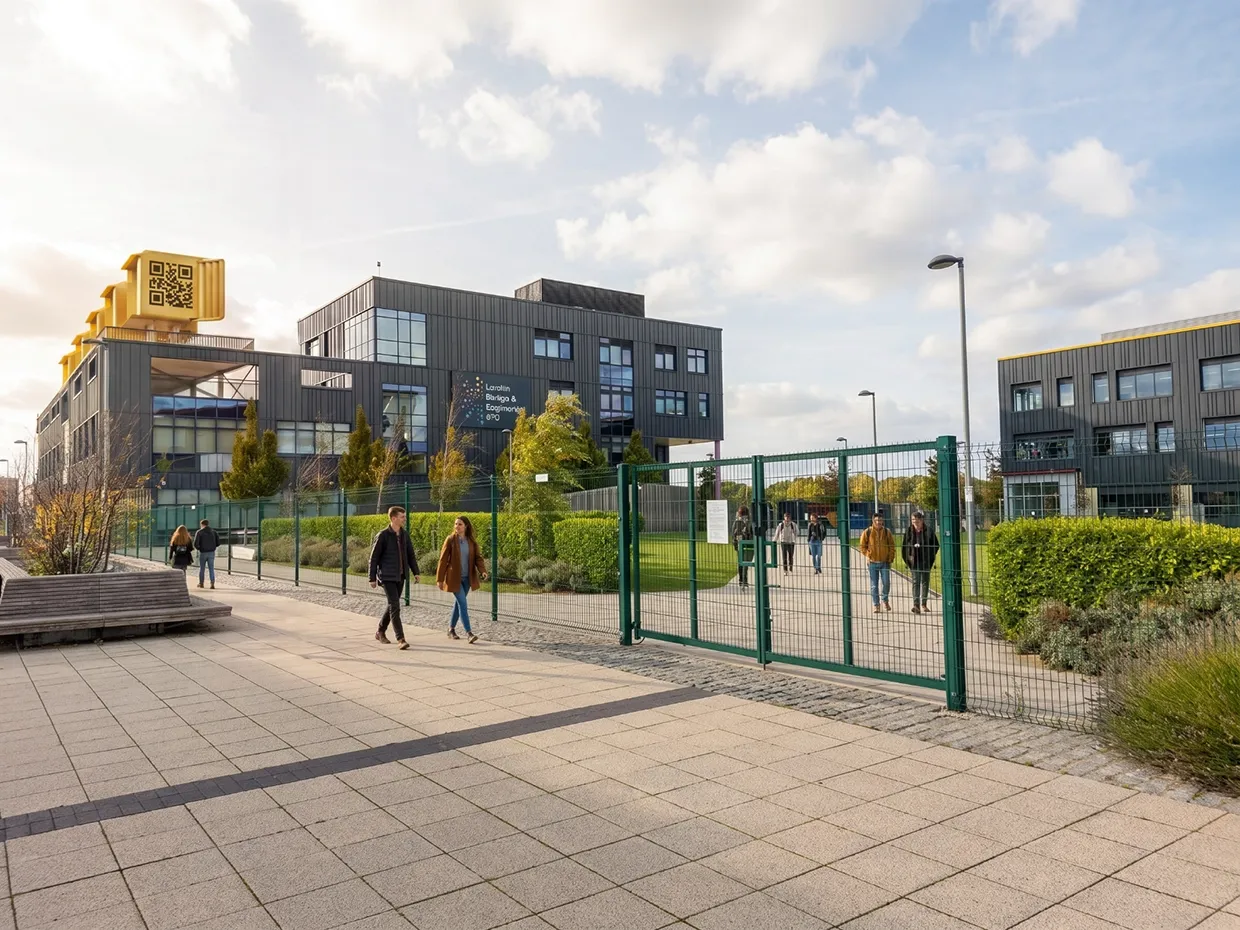
Running alongside the college’s existing rooftop solar panels — and a battery that E.ON is to supply in a later phase — the system is expected to meet around 81 per cent of the building’s electricity demand, according to modelling carried out by Hover with the college.
The airport’s condition
The college’s main building stands directly across Royal Albert Dock from the runway, beneath a flight path, and inside both the airport’s safeguarding area and its public safety zone. The architect’s own site analysis lists that flight path among the constraints on the site, noting that it restricts how tall anything here can be.
The college approached the airport before it applied. According to the planning papers, the airport raised no objection at that stage and did not expect a bird strike risk.
But it gave a different answer when the council consulted it formally. The case officer’s report records that the airport confirmed the proposals had the potential to conflict with its safeguarding criteria, and that it would not object only if a building-induced turbulence study and mitigation scheme were attached as a condition.
That condition now requires the college to commission the study and have it approved in writing before construction begins. It must assess whether the turbines could generate turbulence affecting aircraft operations, taking account of the structure’s height, massing and orientation and of prevailing winds, and set out measures to mitigate anything it finds.
Those measures must be in place before the system is used and kept for its lifetime. The council’s stated reason is to ensure the scheme does not produce turbulence “that could endanger the safe movement of aircraft and the operation of the aerodrome”.
What the study has to establish is whether the turbines and the platform they stand on will disturb the airflow enough to affect aircraft approaching or leaving a runway with unusually tight margins. London City requires a 5.5-degree approach, almost twice as steep as the three degrees standard at most airports, on a runway of 1,508 metres.
The airport also asked for a warning on cranes. Because the site lies within 6km, operators must obtain a permit from its safeguarding team, issued through the Civil Aviation Authority, before any lifting takes place.
Hannah Staunton, director of partnerships at Hover Energy, told the Citizen: “It’s beautiful technology and it’s so forward-thinking of Newham. It’s so fantastic that it’s so close to the airport and so close to a lot of other facilities, and no one thought there was going to be an issue. No one is concerned about this technology at all.”
Nobody wrote in
On that last point the record bears her out. The council advertised the application in the press on 27 May and put up a site notice on 16 June, writing to 73 properties. When the consultation closed four days later it had received nothing at all — not a single letter for, against or neither.
The other bodies consulted also raised no objection, among them the council’s environmental health and transport teams and the lead local flood authority. Historic England had no comment to make.
The council’s own design and conservation officers would not sign the scheme off until the architect supplied more detail on materials, and then asked for conditions covering finishes, detailed drawings and anything fixed to the building’s facade.
‘A long time coming’
Geoffrey Fowler, chief executive and principal of the UTC, told the Citizen: “It’s been a long time coming. If you think back to two years ago, there was lots of turmoil in the world and lots of instability, with the cost-of-living crisis and everything going up.”
Fowler said managing the school budget through that period had been very difficult, and that he was keen to find a more cost-effective solution.
He continued: “We’re a technical school, and we’re all about sustainability and we’re industry-led … so we’re seeing firsthand what the industry is doing. That gives us great opportunities to meet innovative people.”
The project took shape after Fowler met the team at Hover Energy. Both the college and the firm belong to the Royal Docks Sustainability Network, a grouping that also takes in Newham Council, the Greater London Authority and the University of East London, and which supports delivery of the council’s Just Transition Plan. “We’re not just doing our bit, we’re leading the way,” Fowler said. “This should be incredible when it’s done.”
Yellow, and 44 metres wide
The turbines will stand on a 400 square metre gantry along the southern edge of the second-floor terrace, on a maintenance platform running the full 44-metre width of that elevation to catch the prevailing south-westerlies. Each unit is roughly 5.5 metres high, 7.2 metres wide and 4.5 metres deep, with the rotating blade enclosed and none exposed. At their highest point they reach about 16.7 metres above ground, roughly level with the parapet of the main roof.
The yellow picks up the colonnade on the original building’s dock-facing elevation and the entrance and stair cladding of the T Levels block, completed in September last year, though the final shade and finish still need approval.
Scott Brownrigg, the architect, is unabashed about the intent: its design statement calls the turbines intentionally visible, and reaches for the O2, Lloyd’s of London, the Pompidou Centre and the Thames Barrier as precedents for celebrating rather than concealing a building’s engineering.
The college is also weighing up branding for the turbines and what the design statement calls “subtle graphic elements”. Council officers said it was necessary and reasonable to keep a check on that, given how prominent the turbines will be, and the council’s design team noted they would inevitably become key architectural features of the building.
Pupils on the roof deck
The college’s own planning papers say it provides for up to 900 students and 50 apprentices aged 14 to 19. Fowler said the new T Levels building had since taken capacity to 1,200; the permission granted in June 2017 was for 750 places. A screen showing live generation figures is to go into the covered space beneath the platform.
Fowler said: “Our Year 9 students have been running a project for the last year where they’re redesigning the space underneath these turbines, which is on a roof deck, so they can really get to use it [once installed].”
Waiting on Whitehall
The Department for Education was among the bodies consulted on the application, but the project still awaits the department’s final sign-off. Fowler said he was hopeful the college would get the green light.
“We think that we have got a very good business plan there for them,” he said. “If the DfE turn around and say yes, then this is groundbreaking. This could then be delivered in all schools up and down the country.”
The ambition runs further than the five turbines. The design statement says the college aims to generate more energy than it uses and feed surplus power back into the local community or the national grid, and that the microgrid could later be extended across neighbouring plots. Hover, it adds, is already working more widely across the Royal Docks and may bring forward similar schemes elsewhere. The permission runs for three years.