

The airport is seeking permission to allow larger planes to use the airport in Albert Dock, and at lower heights. It says the planes will be quieter than ones currently using the airport, and there will be fewer flights overall.
However Labour assembly member Leonie Cooper fears that “the larger the plane and lower the flight path, the more noisy” the flights will be.
She told the Local Democracy Reporting Service (LDRS): “If the planes are coming in lower, firstly the noise is surely going to be more, and secondly the air pollution is going to be more”.
London City Airport has already been given the go-ahead to increase its annual passenger capacity to nine million. A condition on the airport’s planning permission previously capped passenger numbers at 6.5m a year.
But then-government cabinet ministers Angela Rayner and Louise Haigh agreed to change the condition in 2024 – overruling Newham Council.
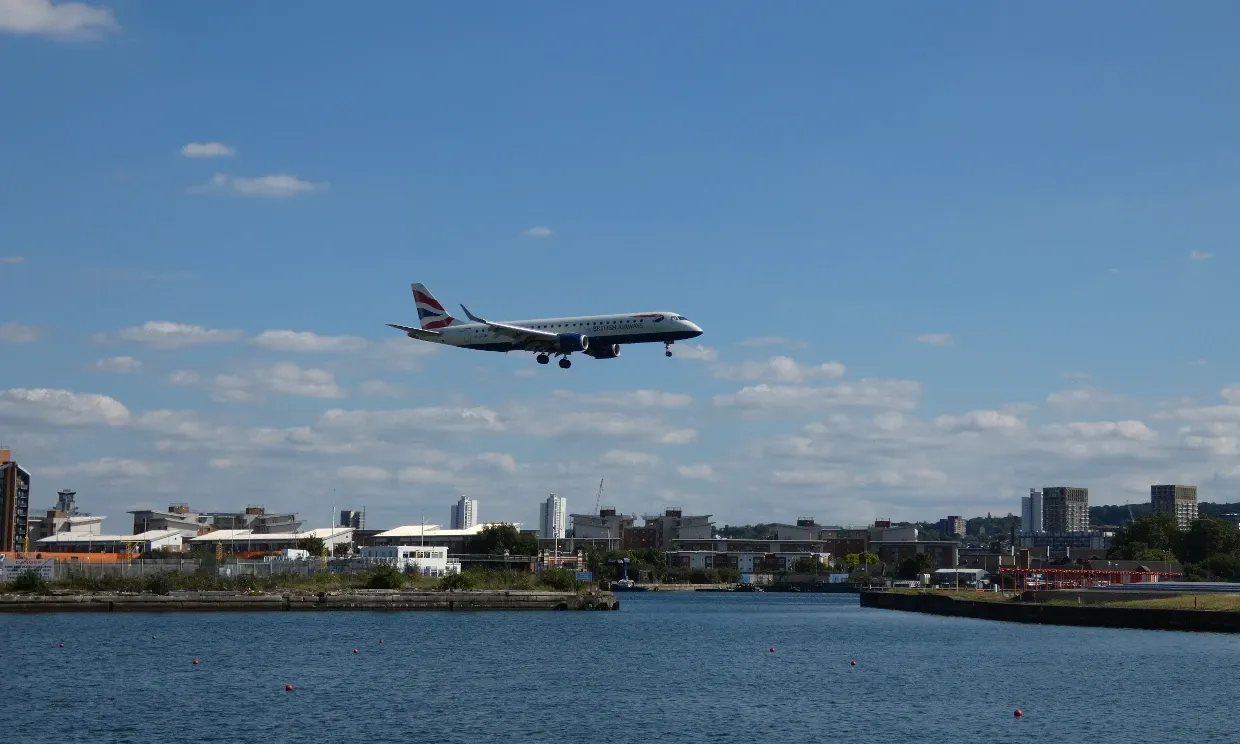
London City now says that in order to increase passenger numbers it needs to allow a larger plane, the Airbus A320neo, to use its runway. For that, it needs permission from the Civil Aviation Authority for planes to land at a shallower angle.
Planes currently approach London City at a steeper angle than usual because of nearby tall buildings.
The airport says new technology means larger aircraft can safely approach at a shallower angle. But Cooper says this will also mean the planes will fly 27 metres lower over the Royal Docks than they do currently.
She fears that will mean louder noise – harming the health of people living nearby.
Cooper said: “It’s absolutely deafening even now. And not everyone living around the airport has got the sort of soundproofing we have at City Hall.
“We know the impact of noise on people’s sleep patterns – it’s really bad for their heart health as well as their mental health. Apparently lack of sleep can even cause obesity.”
Cooper also fears the lower flights will mean people living in Newham will be more exposed to air pollution. She pointed to parliamentary research that found pollution close to airports is “significantly higher than in locations distant and upwind of airports”.
In a recent letter to London City, on behalf of the GLA’s environment committee, Cooper also highlighted a study that suggested the A320neo could result in more noise.
The Aviation Environment Federation produced the report for the anti-expansion campaign group Hacan East in September 2025.
It said the A320neo was quieter than the main aircraft that currently uses London City, the Embraer 190. However it said the E190 is due to be replaced for newer aircraft by 2036, which could be quieter than the A320neo.
A noise impact assessment for City Airport produced in January says the A320neo is quieter than current aircraft, and that airport noise will also travel less far as a result.
It admits that the A320neo is louder that other new planes that could replace the old one, but only “slightly” by less than two decibels, “not perceptible to most people”.
The assessment assumes that other planes using the airport would continue to land at steeper angles.
London City also says that as the A320neo could carry more passengers, there will be 76,500 fewer flights over twelve years.
A spokesperson told the LDRS: “Larger capacity, new‑generation aircraft will mean fewer flights and less noise disturbance for local communities when compared to not making this change over the coming years.”


